A roaster asks for a coffee bag design and gets two quotes back: $400 and $14,000. Both are for "packaging design." The $400 is a front-of-bag mockup. The $14,000 is a brand system with print-ready files for every SKU, prototypes, and a designer who talks to your printer. Neither quote is wrong. They just describe different jobs, and most quotes never say which job they're pricing.
There's also a second bill most roasters don't plan for: the bags themselves. Design is a one-time fee. Printing is per unit, on every reorder, for as long as you sell coffee. This guide covers both. You'll see what designers charge in 2026, what custom bags and labels cost per unit, what changes the price, and why testing sizes and materials first is the cheapest step in the whole process. It also covers what compostable bags actually cost and what you're legally allowed to claim about them.
The Short Answer: What Coffee Packaging Design Costs in 2026
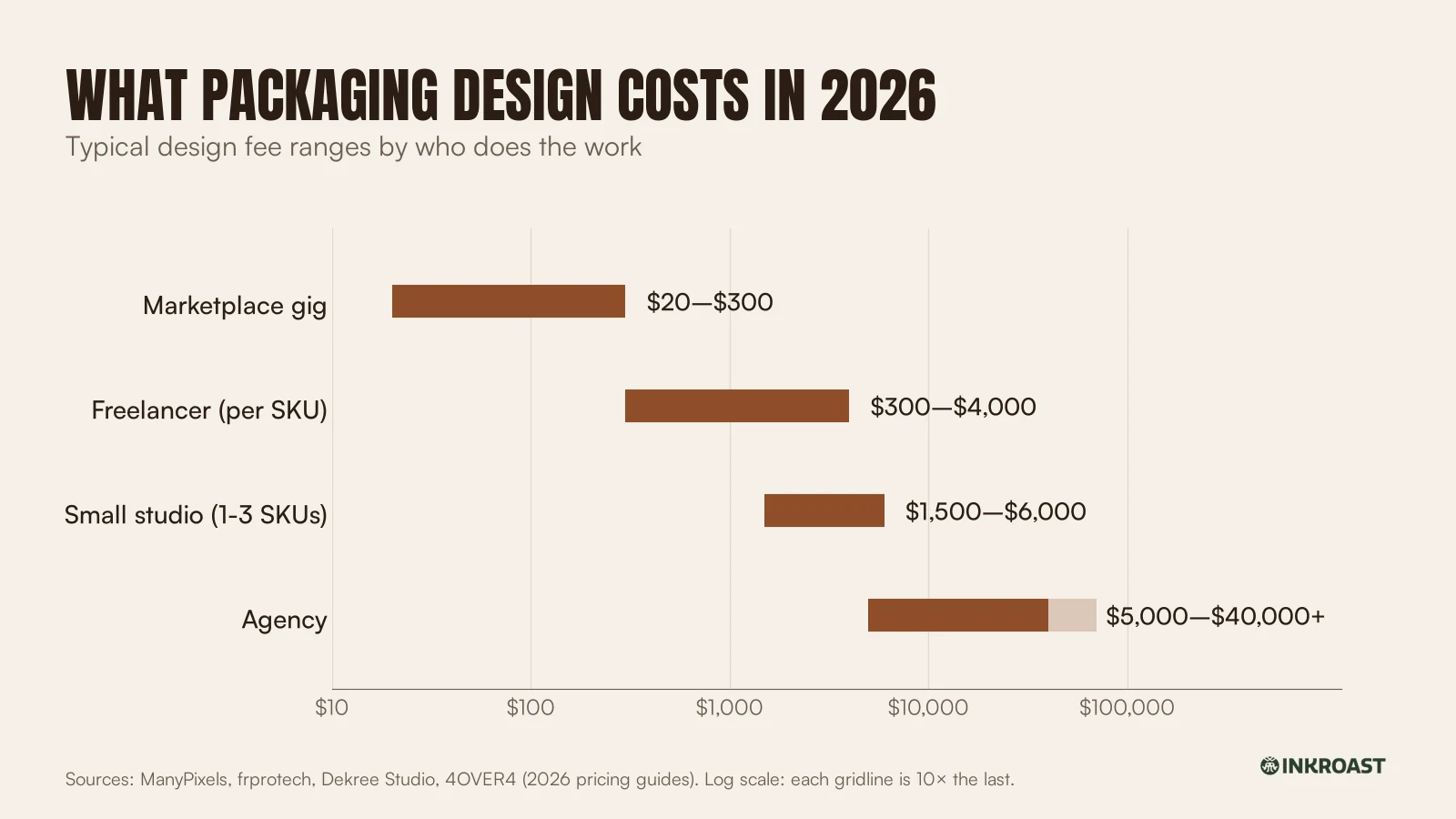
Design fees fall into four tiers. Published 2026 pricing guides put them roughly here:
- Marketplace gig (Fiverr-style) — Typical 2026 price: $20–$300 · What you usually get: A flat front-of-pack mockup. No print-ready dieline, no bleed setup, rarely revisions
- Freelancer — Typical 2026 price: $300–$4,000 per SKU · What you usually get: Print-ready artwork on your printer's dieline, CMYK/Pantone setup, 2–3 revision rounds, source files
- Small studio — Typical 2026 price: $1,500–$6,000 for a 1–3 SKU launch · What you usually get: A reusable design system across SKUs plus print-ready files
- Agency — Typical 2026 price: $5,000–$40,000+ · What you usually get: Research, brand strategy, custom structures, prototypes, full category systems
The most useful number in that research isn't a tier. It's how cost grows with each SKU. One 2026 guide prices the master design for your first SKU at $1,500–$4,000 and each additional SKU in the same system at $600–$1,500. A three-coffee launch lands at $2,700–$7,000. Designing each bag from scratch costs the full master price every time. That's why a range of eight origins designed one bag at a time ends up costing more than one designed as a system.
What You're Actually Paying a Designer For
A low quote usually leaves things out. It doesn't mean the designer works faster. The work that separates a $300 job from a $3,000 job is mostly invisible on a mockup. It covers laying the artwork on the printer's actual dieline, setting bleed and safe zones, getting colors that print correctly, formatting the required copy, and delivering source files you own.
Cheap work gets expensive at the printer. One 2026 guide gives this example: a $1,500 saving on a cheaper designer becomes a $12,000 reprint bill when the files fail the printer's specs. Ask every designer the same question: "Do I get print-ready files on my printer's dieline, and how many revision rounds are included?"
There's one cost to settle before packaging: your brand identity. Pricing guides list logo and identity work separately, usually $300–$5,000, and they all say it comes first. If your logo, colors, and type aren't final, every bag you print will lock in a version you're about to change. Your label is where your brand is most visible, which is why the elements of a brand-strong coffee label should be settled before anyone opens a dieline.
Custom-Printed Bags vs. Stock Bags With Labels
This is the decision that affects your margins every month, long after the design fee is paid.
What a custom bag costs per unit
One 2026 per-unit pricing guide for roasters (digital printing, no plate or setup fees) lists:
- 500 bags — 12oz stand-up pouch: $0.75 · 12oz flat-bottom bag: $1.15 · 12oz kraft pouch: $0.70
- 1,000 bags — 12oz stand-up pouch: $0.52 · 12oz flat-bottom bag: $0.82 · 12oz kraft pouch: $0.48
- 2,500 bags — 12oz stand-up pouch: $0.42 · 12oz flat-bottom bag: $0.72 · 12oz kraft pouch: $0.38
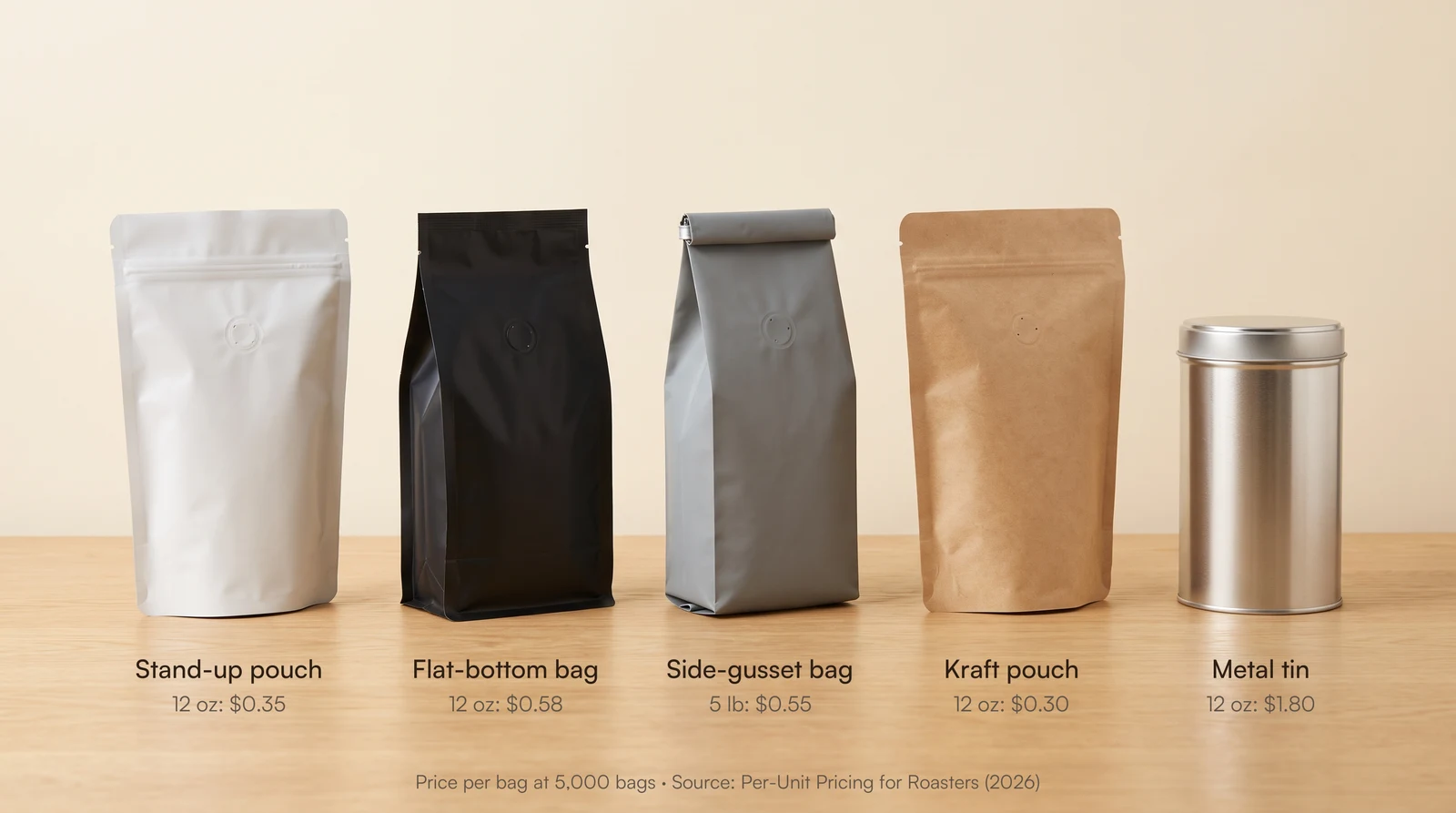
- 5,000 bags — 12oz stand-up pouch: $0.35 · 12oz flat-bottom bag: $0.58 · 12oz kraft pouch: $0.30
- 10,000+ bags — 12oz stand-up pouch: $0.22 · 12oz flat-bottom bag: $0.38 · 12oz kraft pouch: $0.20
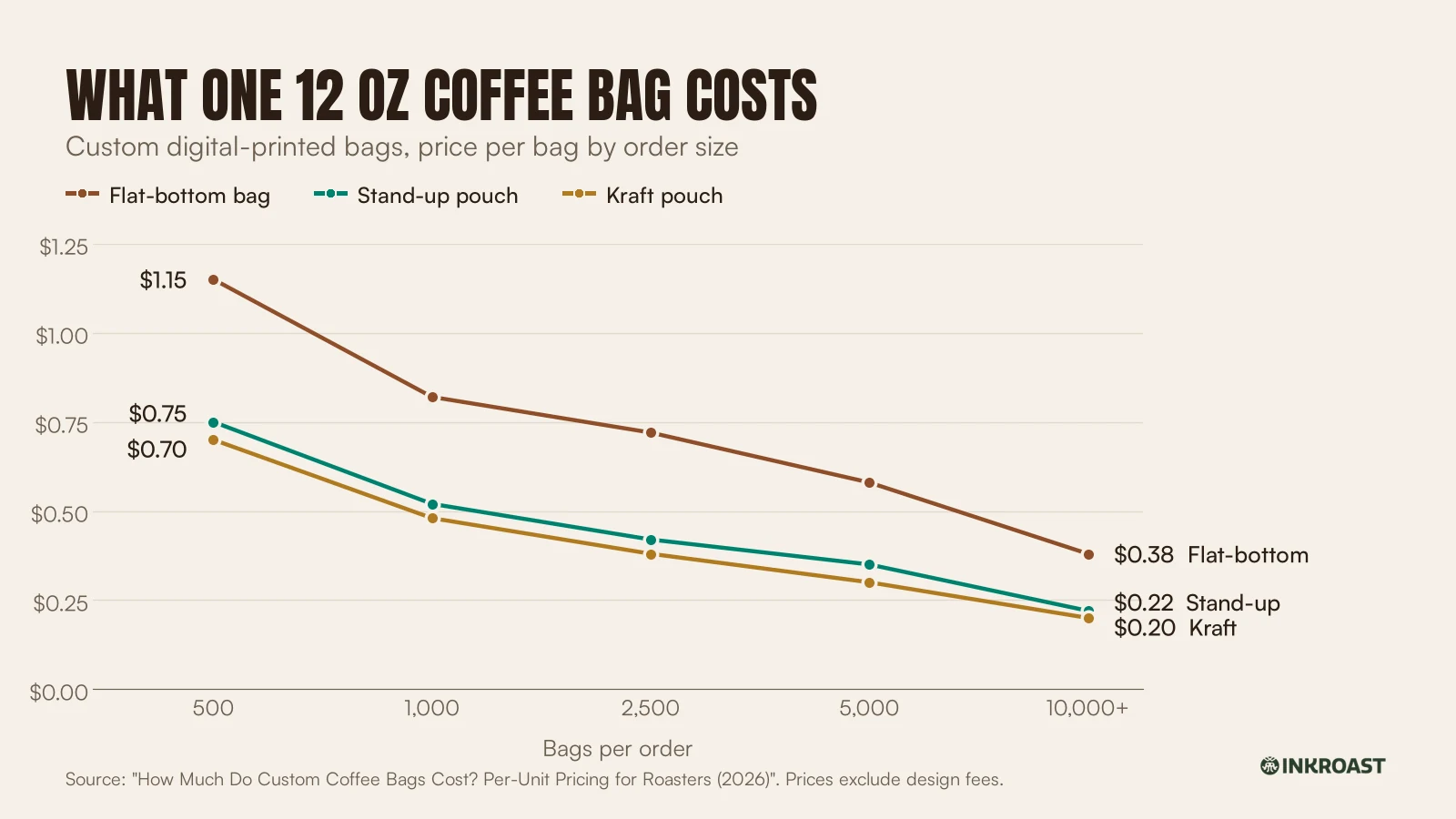
Two things stand out. First, order size matters more than any design choice: the same pouch costs over three times as much at 500 units as at 10,000. Second, bag style matters. Flat-bottom bags look premium on a shelf, but they cost roughly 50–75% more than stand-up pouches at every order size. In that guide, a 12oz tin costs $1.80 at 5,000 units, about three times the price of a flat-bottom bag at the same volume.
What the label route really costs
The same guide prices a blank stock bag plus a custom printed label at about $0.23 per unit. On paper, that's cheaper than a custom bag at every order size below 10,000. So why doesn't everyone do it?
The price list leaves out labor. Someone has to apply every label straight, on every bag, at every reorder. At small volumes that's a fair trade. At a few thousand bags a month, it's a recurring production cost. You also give up edge-to-edge artwork and the control of having your brand printed into the bag itself.
The smartest version of this route, recommended by coffee packaging specialists, is a hybrid. You use one consistent base bag across your whole range and change only a color-coded label for each origin or roast. You get one bag to stock and reorder, and you can still launch new coffees without paying for a new print run.
Digital or plate printing
Digital printing has no plate fees, minimums as low as 500–1,000 units, and turnaround measured in days. It can also print several SKUs in one run. Plate printing (rotogravure) needs engraved cylinders for every color on every SKU, which costs thousands of dollars upfront, with minimums of 10,000 units and up. Past roughly 50,000 bags, it has the lowest per-unit cost in the industry. For most independent roasters, digital is the right call until order sizes say otherwise.
The Factors That Move the Price
Once you've picked a format, add-ons decide the rest. From the same 2026 roaster pricing guide:
- Finishes: standard matte or gloss is usually included. Soft-touch adds about $0.06 per bag, hot foil stamping $0.08–$0.15, and each spot Pantone color $0.02–$0.05.
- Material: kraft runs 10–15% cheaper than custom-colored film because it skips the white base layer. Metallized film instead of full aluminum foil saves about 15%.
- Valves and zippers: often included in the price. Dropping the zipper for a tear notch saves only about $0.02.
- Number of bag sizes: every unique size needs its own cutting die. Standardizing on one size saves $400–$800 in tooling.
- Number of SKUs: each SKU adds design time. With plate printing it also adds a cylinder set.
- Rush timelines: a compressed design schedule adds 20–50%. A single label takes 1–3 weeks to design and a multi-SKU system 4–8 weeks. Plan around that.
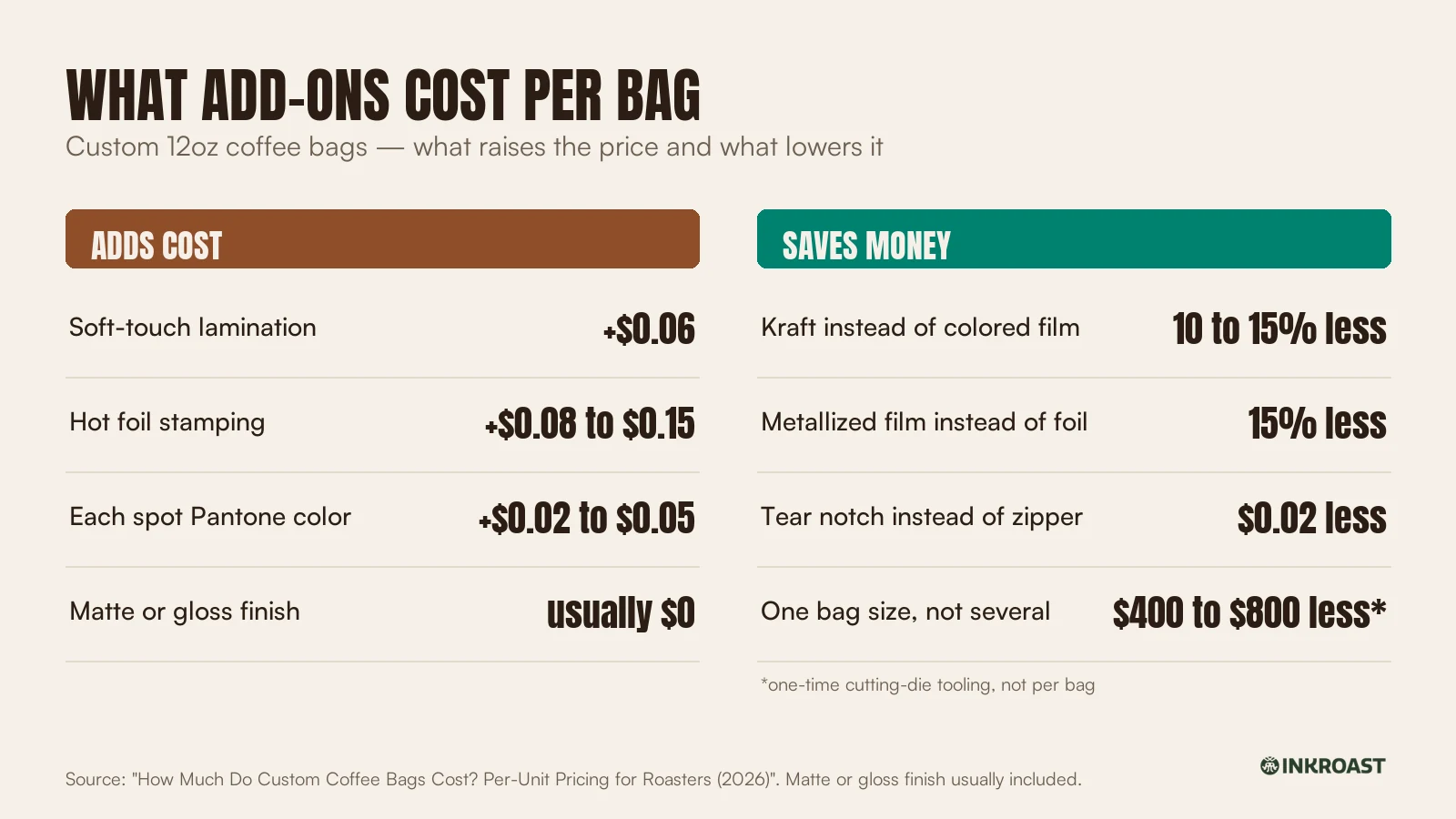
The pattern: the finishes buyers notice cost cents per bag. The decisions buyers never notice, like extra sizes, a design that isn't a system, and rushed timelines, cost hundreds or thousands.
Why You Test Sizes and Materials Before You Print
Samples are the cheapest insurance in packaging. Proofs and stock sample packs are often free, and short test runs cost a few hundred dollars. Here's what they catch before you're holding 5,000 bags you can't use:
- Fit. Coffee volume changes with roast level, and darker roasts take up more space by weight. Fill a sample with your actual coffee before you commit to a size. A 12oz bag that's too tight won't seal cleanly, and one that's too loose looks underfilled.
- Shelf stand. A stand-up pouch should actually stand up on a café shelf, and a peg-hung bag shouldn't sag.
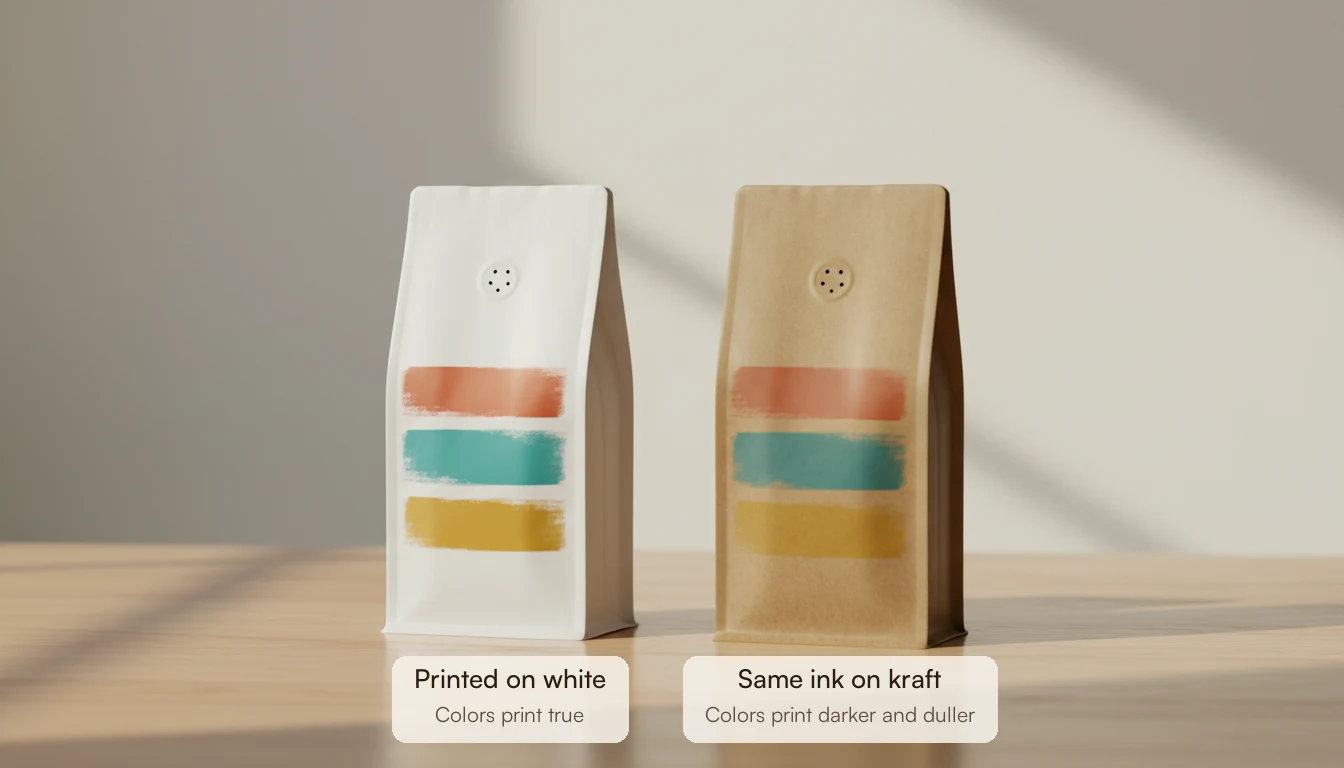
- Color shift on kraft. Artwork printed straight onto kraft, with no white base, looks noticeably different from the screen proof. Your brand color might come out muddy.
- Valve placement. Check that the one-way degassing valve isn't sitting under your logo or folded into a gusset, and that it vents freely after filling.
- Shipping. Make sure the filled bag fits your mailer. A few millimeters too tall means damaged bags or repacking.
The downside is bigger than reprints. The best-known packaging cautionary tale is Tropicana's 2009 redesign: sales reportedly fell 19% within two months, and the brand switched back. You're not Tropicana, but the principle holds at any size. Packaging that fails on the shelf costs more than packaging that took an extra week to test. Before peak season, it's also worth running a shelf-ready inventory check so you don't run short of bags just when demand jumps.
2026 Packaging Trends Worth Paying For
Not every trend earns its cost. These four do, because they also make your packaging cheaper or easier to sell:
- Modular, color-coded SKU systems. One base design, with a color, label, or accent panel that changes per origin or roast. It's the trend most often recommended in the research, and it's also the cheapest way to scale a range.
- The 3-second front panel. Shoppers decide in seconds. Strong color blocking, one clear hero claim, and bold type beat a front panel crammed with tasting notes.
- QR codes that carry the origin story. Put the farm, producer, processing method, and brew guide behind a code instead of squeezing them onto the bag.
- Short seasonal runs. Digital printing makes limited editions affordable at a few hundred bags, with no plates to pay off.
Your bag also has to look right on screen. Most of your buyers will see it first in a product photo, which is why briefing a photographer properly belongs in your packaging budget.
Compostable Coffee Bags: Cost, Trade-Offs, and the Claims You Can Make
Sustainability is now a baseline expectation in packaging. McKinsey's 2025 global packaging survey of more than 11,000 consumers found that most say they'd pay more for sustainable packaging. Younger and higher-income buyers say so most often. That's what people say in a survey, which isn't the same as what they buy. Price and quality still lead the decision. Go in with clear eyes on four things.
1. Cost. A 2026 roaster cost guide from CoffeeTec puts compostable PLA and paper bags at about 10–25% more than a traditional metallized laminate, for a 12oz bag at 10,000 units. At small quantities the gap widens. Ready-to-ship compostable 12oz pouches with valves are listed around $0.95 each in packs of 100.
2. Freshness. Compostable films generally let more oxygen and moisture through than multi-layer foil. Full foil laminates are built for 12–24 month shelf life. Lighter structures suit coffee that's sold and brewed within a few months of roast, like a direct-to-consumer subscription. If your coffee sits in wholesale accounts for months, ask your supplier for the oxygen and moisture transmission rates of the exact structure they're quoting, not the brochure.
3. The valve. Check that the valve and zipper are certified compostable, not just the film. Some suppliers' compostable bags still use a conventional plastic valve, so the bag as a whole isn't compostable.
4. The claim on the bag. Under the FTC's Green Guides (16 CFR 260.7), a "compostable" claim needs reliable scientific evidence that the package breaks down into usable compost in a safe and timely way. The claim must also be qualified if the bag can't be composted at home, or if composting facilities aren't available to a substantial majority of the people you sell to. In practice, that means writing "Commercially compostable — facilities may not exist in your area" rather than a bare "compostable" leaf icon. If you print recyclable symbols, California's SB 343 rules also apply to packaging manufactured after October 4, 2026. Certifications such as BPI (commercial composting) or TÜV OK compost HOME are what back a claim up, so ask your supplier for the certificate, not just the marketing sheet.
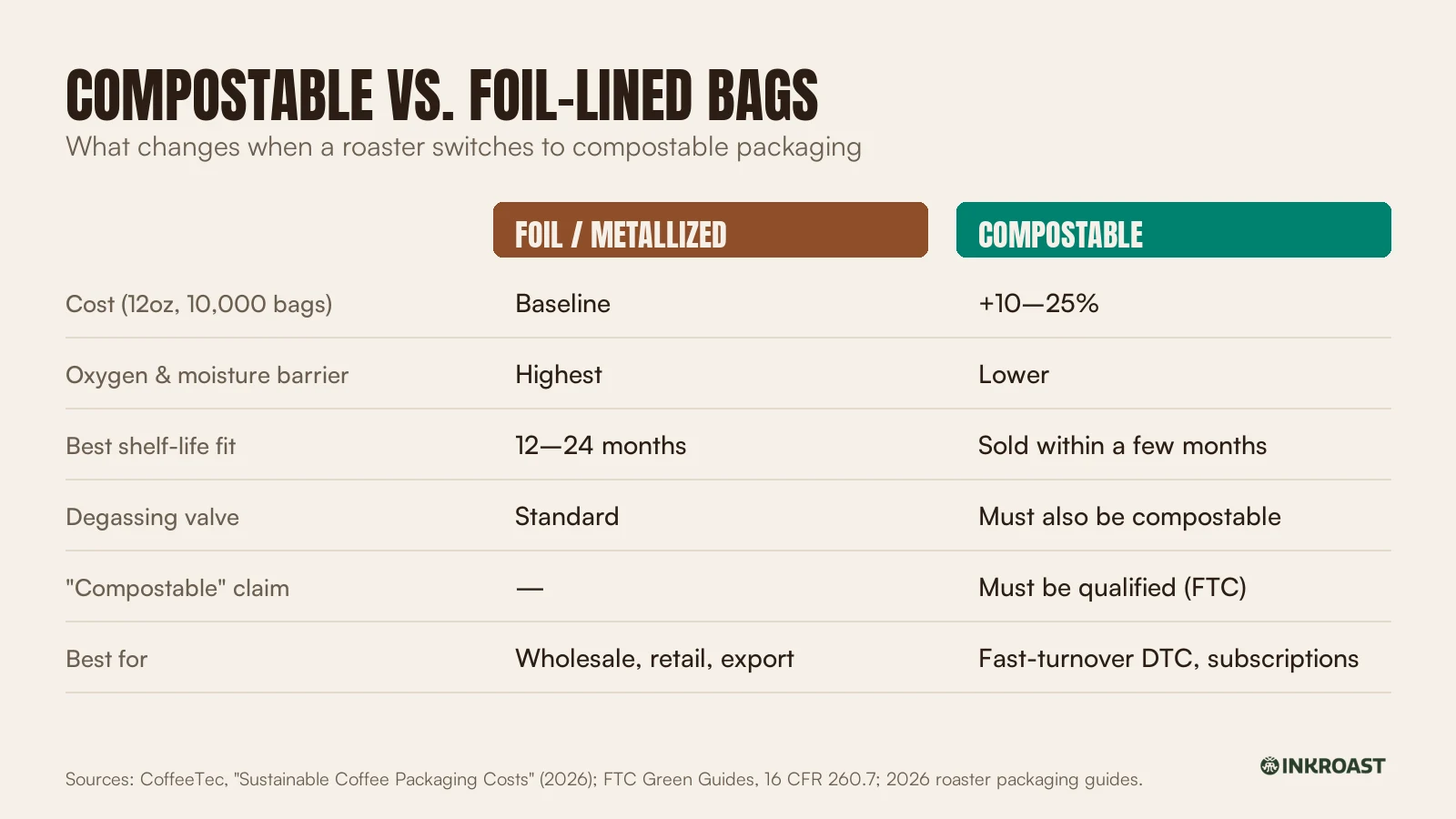
Compostable is a strong choice when your coffee turns over fast and your buyers care. It's a weak choice when it shortens shelf life in a wholesale channel or comes with a claim you can't back up. Recyclable mono-material bags and kraft are middle options worth pricing out too.
How to Budget Packaging Without Paying Twice
- Lock your brand before your bag. Logo, colors, and type final, or you'll be paying for the bag twice.
- Design a system from SKU one. Brief one master design that flexes across origins, so every new coffee costs the additional-SKU rate, not the full master price again.
- Pick one bag size if you can. Fewer dies, simpler reorders, cleaner shelves.
- Start on stock bags plus labels if volume is low. Count the labeling labor honestly, and move to custom print when that labor costs more than the per-unit savings.
- Sample before you scale. Fill it with your coffee, ship it to yourself, put it on a shelf.
- Compare quotes on the same scope. SKUs, revision rounds, print-ready files, dieline work, and who handles the printer.
Packaging works best when it's part of the same system as your store, your content, and your sales. It shouldn't be a one-off project you redo every two years. That's the idea behind running one system instead of two strategies. And when the bags are ready, the rest of your launch budget is next.
Frequently Asked Questions
How much does packaging design cost for a coffee brand?
In 2026, freelancers typically charge $300–$4,000 per SKU, small studios $1,500–$6,000 for a 1–3 SKU launch, and agencies $5,000–$40,000 or more. Additional SKUs designed within one system usually cost $600–$1,500 each, far less than designing every new bag from scratch each time.
Is a custom-printed coffee bag cheaper than a stock bag with a label?
Not at small volumes. A stock bag plus a custom label runs about $0.23 per unit, while a custom 12oz stand-up pouch costs about $0.75 at 500 units and drops to about $0.22 at 10,000 or more. The label route also needs labor to apply each label, which grows with volume.
What is the minimum order for custom coffee bags?
With digital printing, many suppliers start at 500–1,000 bags with no plate fees. Plate printing (rotogravure) usually requires 10,000 bags or more per design and thousands of dollars in cylinder costs, so it only makes sense once your volume is high.
Do compostable coffee bags cost more?
Yes. One 2026 roaster cost guide puts compostable bags at roughly 10–25% more than a traditional metallized bag at 10,000 units, and the gap is larger at small quantities. Compostable films also tend to have lower oxygen and moisture barriers, which can shorten shelf life.
Should I order samples before printing coffee bags?
Yes. Samples and proofs are often free or cheap, and they catch the most expensive mistakes: a bag that doesn't fit your roast, colors that shift on kraft, a badly placed valve, or a bag that won't stand up or fit your mailer.
The Bottom Line
Coffee packaging in 2026 comes with two bills: a one-time design fee and a per-bag print cost you pay on every reorder. Design costs anywhere from a few hundred dollars to tens of thousands, depending on scope and how many SKUs share one system. Bag costs depend on order size, bag style, and material much more than on finishes. Lock your brand first, design a system, test before you scale, and weigh compostable materials against your shelf life and the claims you can actually support. Spend where buyers feel it, and don't pay for the same bag twice. Follow us for more on building a coffee brand that sells.