The first purchase is the hardest thing to earn in DTC coffee.
It required weeks or months of content, the right product page, enough social proof, and a moment when a visitor decided to trust a brand they might have only discovered recently. All of that — the content creation, the Shopify optimization, the paid or organic reach — costs time and money. Every dollar invested in acquisition has to earn its return from that first transaction.
Which is why it is so striking how little most DTC coffee brands invest in what comes after.
The second purchase, the third, the subscription — these cost a fraction of the first to earn. The customer already knows you. They already trusted you once. They've tasted the coffee. Everything that made the first purchase hard has already been resolved. Retention is the highest-ROI channel in direct-to-consumer coffee, and most brands are running it almost by accident.
This is the exact system we build for Inkroast clients who want to turn first-time buyers into repeat customers.
Why Retention Is the Highest-ROI Channel in DTC Coffee
In e-commerce broadly, the cost of acquiring a new customer is typically five to seven times higher than the cost of retaining an existing one. In specialty coffee specifically, the gap is often wider — because coffee is a consumable with a natural repeat purchase cycle, and because buyers who are loyal to a coffee brand tend to stay loyal.
The math behind a subscription model makes this concrete. A one-time buyer who purchases twice in a year contributes two transaction values. A subscriber who receives a monthly bag contributes twelve — plus the reduced acquisition cost, reduced customer service overhead, and predictable revenue planning that subscriptions enable. The lifetime value difference between a one-time buyer and a subscriber in DTC coffee is consistently four to six times.
Most brands understand this in principle. The gap is implementation — specifically, the lack of a deliberate retention system that operates in the critical window immediately after the first purchase.
That window — the 24 to 72 hours after the package is delivered — is the highest-engagement moment in the entire customer relationship. The buyer has just received something they paid for, they're holding the product, and they're forming their first real impression of the full brand experience. What happens in that window determines whether they return.
The 3-Part Retention System
Part 1 — The Unboxing Experience
The package arrives. The buyer opens it. This is the moment.
Most DTC coffee orders arrive in a plain shipping box with functional packing — either kraft paper fill or bubble wrap — the bag, and a printed packing slip. The product is fine. The experience communicates: this is a transaction. Nothing about it invites the buyer back.
The goal of the unboxing experience is to deliver a physical signal that says someone was intentional about this. That intention is the foundation of the second purchase.
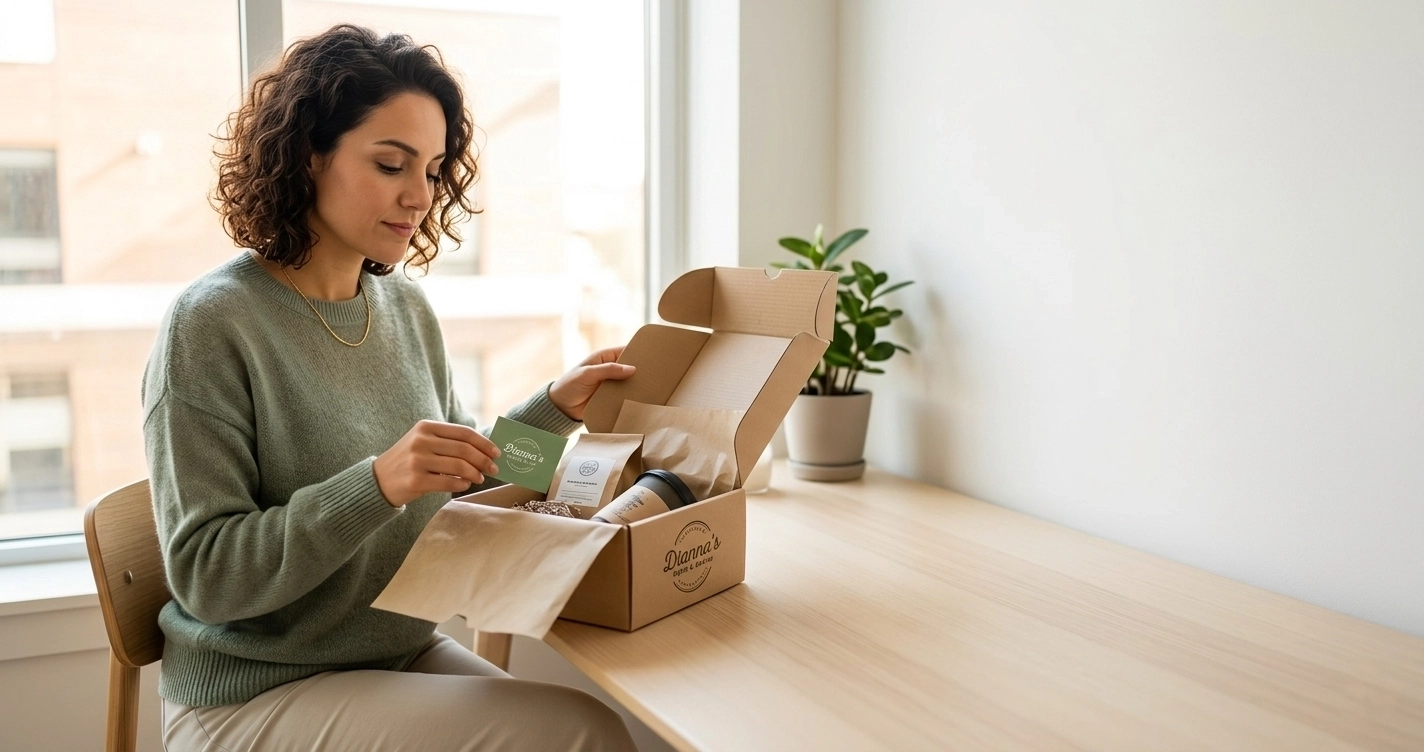
The details that do this without significant cost: a small branded insert card with copy that is specific to the product they bought — not "thank you for your order" but something that talks about this coffee, this origin, this roast. If your volume is small enough, a brief handwritten note from the roaster. Kraft tissue paper around or inside the bag, and a branded seal. These details are not expensive. Collectively they communicate: this brand cares about the moment its product arrives in your hands.
The unboxing experience also creates user-generated content. Buyers who receive an intentional package take photos. They share them. That organic sharing is acquisition at zero cost — and it starts with the same investment in physical experience that drives retention.
Part 2 — The Post-Purchase Email Sequence
The post-purchase window is the most underused moment in coffee brand email marketing.
A buyer who just received their first order is at maximum engagement with the brand. They're curious, probably brewing their first cup, forming their first real opinion. An email that arrives in this window and does the right things will be opened at a dramatically higher rate than any other email you send.
What the right post-purchase email does: it arrives within 24–48 hours of delivery confirmation (not the order confirmation — the delivery), it acknowledges the specific product they bought, it gives them something useful — how to brew this particular coffee, what to expect from this origin, what food pairs with this roast — and it asks for a review.
The review ask is important and often skipped. A buyer who has just received their first order and had a positive unboxing experience is the most likely person to leave a review. That review is social proof for the next first-time buyer. The post-purchase email is how you capture it at the exact right moment.
The second email in the sequence — sent 10–14 days after delivery, when the coffee is likely running low — introduces the option to buy again, or to subscribe. This email should be brief and direct. "Almost out? This is the one-click way to make sure you never run low."
Part 3 — The Win-Back Sequence
Not every first-time buyer responds to the post-purchase sequence immediately. Some will come back on their own timeline. Some need a reason.
The win-back email — sent 90 days after the last purchase with no follow-on order — is the simplest retention tool most brands are not running. It does not need to offer a discount. In many cases, a discount actually cheapens the brand and sets a precedent the buyer will expect every time.
What a strong win-back email does: it acknowledges the gap honestly and with warmth, it introduces something new if there is something new (a seasonal offering, a new origin, a changed roast profile), and it gives a genuine reason to return that is about the coffee, not about the price.
If your win-back emails consistently do not perform, the issue is usually one of two things: the email arrives too late (120 days is too long in coffee — 90 days is usually right), or the email is too promotional in tone. Win-back in specialty coffee is a relationship re-opening, not a sales pitch.
The Subscription Model — And When to Introduce It
Subscriptions are the end state of a working retention system — not the starting point.
The mistake many coffee brands make is introducing subscriptions too early, before the product-market fit is clear and before the brand has enough social proof and reviews to make a recurring commitment feel safe to a first-time buyer. Subscriptions work when buyers already trust the brand. They do not build trust on their own.
The right moment to introduce subscriptions: once the brand has at minimum three to four months of operations, a meaningful number of verified reviews, and clear product positioning. At that point, subscriptions should be introduced at the post-purchase stage — specifically in the day-10 email, when the buyer has already formed a positive first impression and is beginning to think about the next bag.
The subscription offer should be positioned not as a convenience feature but as a commitment to the brand's standards. "We roast and ship to order — subscribing means your coffee is always fresh, always from this week's roast." That framing makes the subscription feel like a premium choice, not a discount.
Frequently Asked Questions
How do you increase repeat purchases for a DTC coffee brand?
Repeat purchases in DTC coffee are built at three moments: the unboxing experience (intentional packaging that signals the brand cares), the post-purchase email sequence (a delivery-triggered email that deepens the relationship and captures a review), and a win-back sequence for buyers who haven't returned in 90 days. These three systems, running together, consistently outperform any single promotional campaign in terms of retention impact.
What should a post-purchase email for a coffee brand say?
A post-purchase email for a coffee brand should arrive within 24–48 hours of delivery, reference the specific product the buyer received, offer something genuinely useful (brewing guidance, origin context, food pairing), and include a direct ask for a review. It should feel like it came from a person, not an automated system — because in specialty coffee, the human relationship behind the brand is part of what the buyer is paying for.
When should a coffee brand introduce a subscription model?
Introduce subscriptions once the brand has at least 90 days of operation, a meaningful number of verified reviews, and clear product positioning. The right moment within the customer journey is the 10–14 day post-purchase email, when a first-time buyer has already formed a positive impression and is starting to think about their next bag. Position subscriptions as a quality commitment, not a discount mechanism.
The Second Purchase Is Where the Business Begins
Every coffee brand lives or dies on repeat purchase.
The first sale proves you can convert. The second proves you have a business. The subscription proves you have a brand.
The gap between those three stages is almost always a retention system — or the lack of one. The three-part system in this post — unboxing experience, post-purchase email, win-back sequence — does not require a large team or a significant budget. It requires deliberate setup and the discipline to let it run.
The first purchase was the hardest to earn. Make sure the second one is the easiest.