Most coffee brands obsess over acquisition. New followers, new ad campaigns, new market booths. And while getting new customers matters, it's the second purchase — not the first — that determines whether you have a business or just a store.
The economics are stark: acquiring a new customer costs five to seven times more than retaining an existing one. A customer who buys twice is exponentially more likely to buy a third time. And loyal repeat customers spend, on average, 67% more per order than first-time buyers.
Here's how to build a system that turns one-time buyers into customers for life.
Why Most Coffee Brands Lose Customers After the First Order
The pattern is predictable. Someone discovers your brand — through Instagram, a market stall, a friend's recommendation — and places their first order. The coffee arrives. It's good. Maybe it's great.
Then nothing.
No follow-up. No "how was it?" No reason to come back. Two weeks later they order from a different brand, not because your coffee was bad, but because no one reminded them you exist.
This isn't a product problem. It's a retention system problem. And it's one of the easiest problems to fix.
The Post-Purchase Sequence That Works
A post-purchase retention system doesn't need to be complicated. The following five touchpoints, executed well, will significantly improve repeat purchase rates for most coffee brands.
Touchpoint 1: The Order Confirmation (Day 0)
You already send this. The question is whether it sounds like a brand or a logistics company.
Most order confirmation emails look like receipts with a logo slapped on top. The high-retention version looks like a welcome letter from a person who's genuinely glad you placed the order.
What to include:
- A short, human note from the founder (2–3 sentences, no template language)
- What to expect when it arrives (freshness window, suggested brew method for what they ordered)
- A small surprise — an early look at an upcoming roast, a recipe, something they didn't expect
You're not just confirming a transaction. You're opening a relationship.
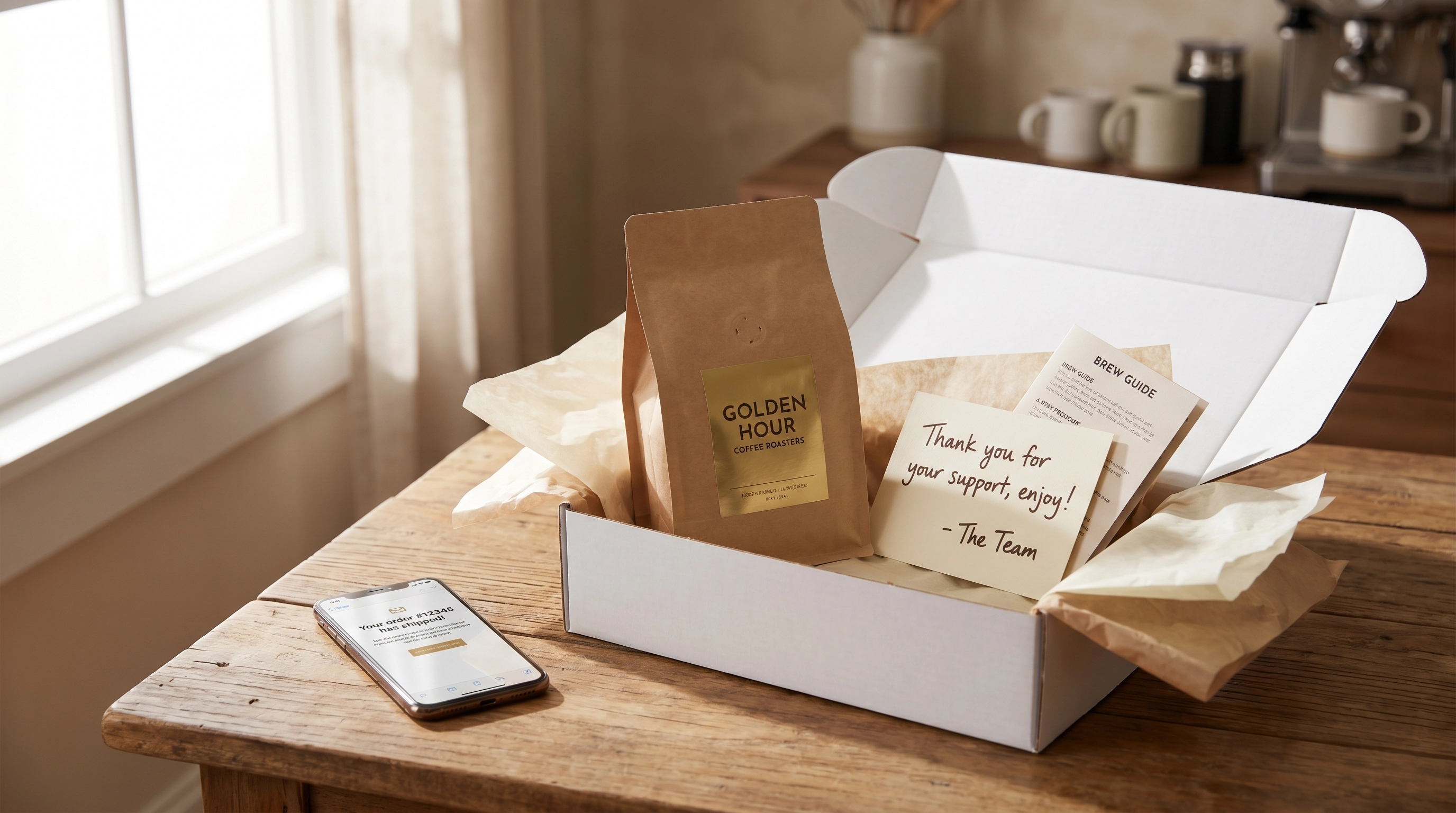
Touchpoint 2: The Unboxing Experience (Day 2–4)
The moment someone opens your package is the highest emotional engagement point in the entire customer journey. Most brands treat it as a logistics problem. The best brands treat it as a marketing opportunity.
This doesn't require expensive packaging inserts. A single well-written card — handwritten or printed — creates a disproportionate impression. Include:
- A sentence or two about the specific roast they ordered
- A brew tip or flavour note they wouldn't have found on the product page
- A soft invitation to tag you if they share their first cup
The goal is to make opening the package feel like the beginning of something, not the end of a transaction.
Touchpoint 3: The "How Was It?" Email (Day 7)
Seven days after delivery, send a single email with one question: "How was it?"
Not a review request. Not a survey. A genuine "hey, I want to know if you loved it."
If they reply (and people do reply to this kind of email), respond personally. This single exchange — a customer getting a real response from a real person — is more valuable than any loyalty program.
You can also include:
- A brew guide specific to what they ordered
- A note about your next seasonal roast
- An easy way to reorder with one click
Touchpoint 4: The Replenishment Reminder (Day 21)
Coffee runs out. The average 250g bag lasts a daily drinker about 2–3 weeks. The average 12oz bag lasts 10–14 days.
At day 21, send a simple email: "Running low? Your next bag is ready when you are."
This is not a pushy upsell. It's helpful timing. The customer is likely looking at an almost-empty bag right now — your email showing up at this moment feels like good service, not marketing.
Include a direct link to the product they ordered, a subscription option, and a short note about what else is currently in rotation.
Touchpoint 5: The Loyalty Signal (Day 30–45)
After a customer has completed their first full cycle, give them a signal that their loyalty matters.
This doesn't need to be a discount. In fact, a discount can sometimes cheapen the relationship if overused. Consider:
- Early access to a limited or seasonal roast
- An invitation to a tasting event or virtual Q&A
- A "you're part of this community now" message with something exclusive
The goal is to make the customer feel like they're on the inside. That feeling of belonging is one of the most powerful retention mechanisms available to small brands — and it's one that large brands genuinely cannot replicate.
The Role of Subscriptions
If you're not offering subscriptions, you're leaving your most reliable revenue source untapped.
A subscription converts your retention system from reactive (send emails, hope they reorder) to proactive (they've already committed to reordering). The customer gets convenience and often a small price benefit. You get predictable revenue and significantly higher lifetime value.
Start with your two or three bestselling SKUs. Offer a 10–15% discount on subscribe-and-save. Make cancellation easy — counterintuitively, easy cancellation increases subscription retention because it removes the anxiety of feeling locked in.
Klaviyo, ReCharge, and Shopify Subscriptions all integrate cleanly with most Shopify setups. This is a one-week project that pays off indefinitely.
Measuring What Works
Two metrics matter most for retention:
Repeat purchase rate: What percentage of customers who buy once buy again within 90 days? If it's under 20%, your retention system needs work. Over 35% is strong for a specialty coffee brand.
Time to second purchase: How long does it take a first-time buyer to come back? Shortening this window — through better post-purchase emails, better replenishment timing — compounds into significant revenue growth over a year.
Track these in Shopify Analytics or Klaviyo. If you're not tracking them, start now. You can't optimize what you don't measure.
The Mindset Shift
The best coffee brands I've worked with don't think of customers as transactions. They think of them as relationships.
Every email, every card in the box, every reply to a DM is a deposit in a relationship account. When you need to ask something of that customer — to reorder, to refer a friend, to leave a review — the ask lands differently when there's already a balance.
Retention isn't a funnel. It's a relationship. Build it that way.
Inkroast helps coffee brands build the strategy, packaging, and systems to grow sustainably. Follow @theinkroast for weekly brand and e-commerce tips.