Most coffee brands obsess over acquisition. New followers, new ad campaigns, new market booths. And while getting new customers matters, it's the second purchase — not the first — that determines whether you have a business or just a store.
The economics are stark: acquiring a new customer costs five to seven times more than retaining an existing one. A customer who buys twice is exponentially more likely to buy a third time. And loyal repeat customers spend, on average, 67% more per order than first-time buyers.
Here's how to build a system that turns one-time buyers into customers for life.
Why Most Coffee Brands Lose Customers After the First Order
The pattern is predictable. Someone discovers your brand — through Instagram, a market stall, a friend's recommendation — and places their first order. The coffee arrives. It's good. Maybe it's great.
Then nothing. No follow-up. No "how was it?" No reason to come back. Two weeks later they order from a different brand, not because your coffee was bad, but because no one reminded them you exist.
This isn't a product problem. It's a retention system problem. And it's one of the easiest problems to fix.
The Post-Purchase Sequence That Works
A post-purchase retention system doesn't need to be complicated. The following five touchpoints, executed well, will significantly improve repeat purchase rates for most coffee brands.
Touchpoint 1: The Order Confirmation (Day 0)
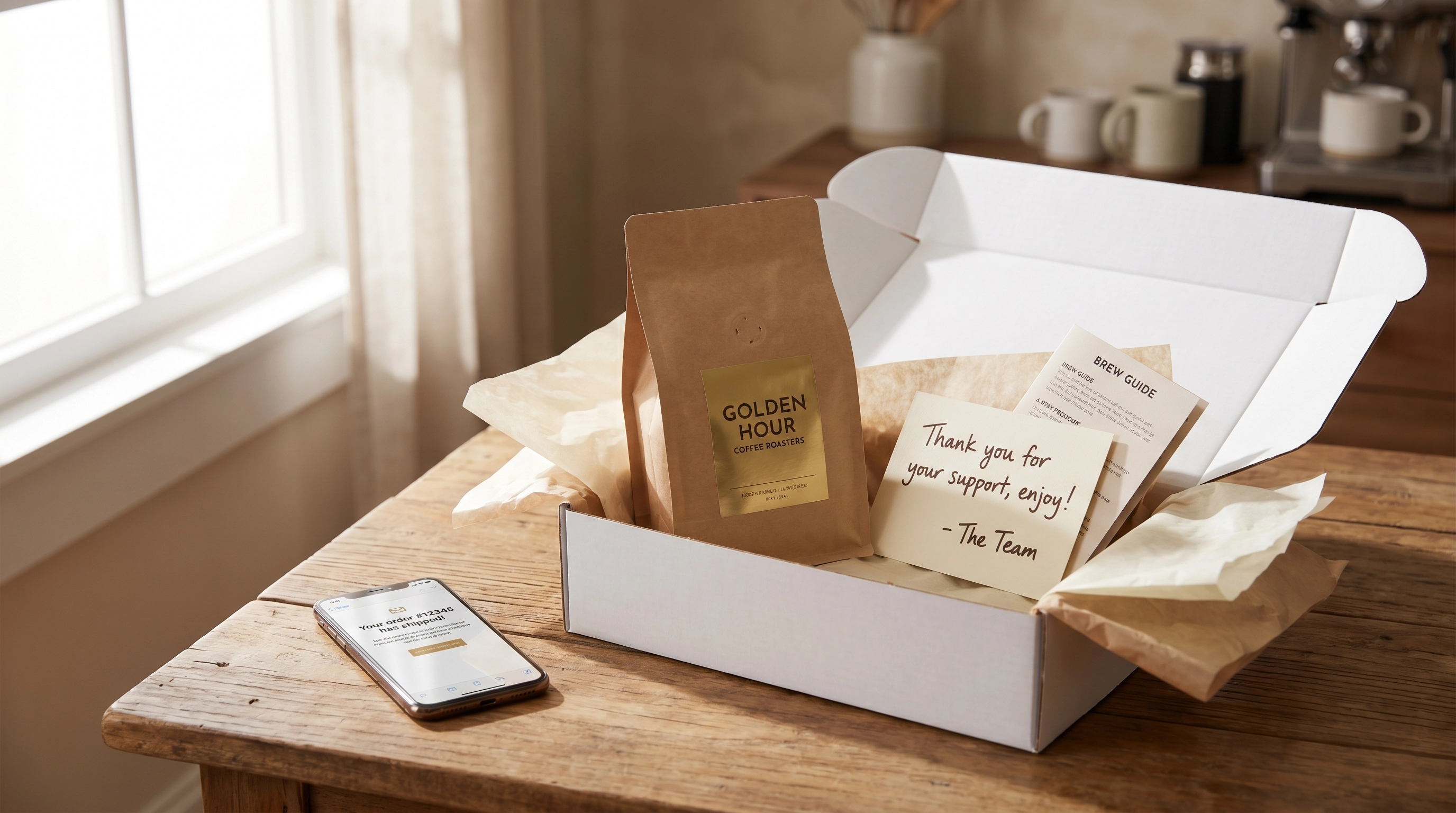
You already send this. The question is whether it sounds like a brand or a logistics company. Most order confirmation emails look like receipts with a logo slapped on top. The high-retention version looks like a welcome letter from a person who's genuinely glad you placed the order.
- A short, human note from the founder (2–3 sentences, no template language)
- What to expect when it arrives (freshness window, suggested brew method for what they ordered)
- A small surprise — an early look at an upcoming roast, a recipe, something they didn't expect
Touchpoint 2: The Arrival Check-In (Day 5–7)
Most packages arrive within a week. This is the moment your customer is most likely to try the coffee for the first time. A short email — genuinely short, not newsletter-length — asking how it's going and offering a brew tip converts remarkably well.
The subject line matters more than anything else here. "How's the Ethiopian?" outperforms "We hope you're enjoying your order" by a wide margin. Specificity signals that you remember who they are.
Touchpoint 3: The Replenishment Prompt (Day 18–21)
If someone ordered a 250g bag and brews once or twice a day, they're probably running low around day 18. This is the highest-intent moment in the post-purchase journey — they want more coffee, and if you show up at exactly the right time, you don't need to work hard to convert them.
Keep it simple: "Running low? Here's a quick reorder link." No discount required at this stage. Timing is the conversion lever.
Touchpoint 4: The Loyalty Signal (Day 30)
At the one-month mark, a customer who hasn't reordered is drifting. This is the moment to give them a reason to come back that has nothing to do with a generic discount code. Options that work well for specialty coffee brands: early access to a new release, a behind-the-scenes look at an upcoming roast, an invitation to a tasting event, or a "for regulars" offer that makes them feel like an insider rather than just a conversion target.
Touchpoint 5: The Subscription Offer (Day 45–60)
By six weeks, you know something important: this person likes your coffee enough to have bought it once and engaged with your follow-up. This is the optimal moment to introduce a subscription — not at checkout (too early), not in the first week (too pushy), but at the point where the relationship has been established.
Frame the subscription as a benefit, not a commitment: "Never run out. Always fresh. Cancel any time." The freshness angle is especially compelling for specialty coffee buyers who already understand the value of receiving coffee at its peak.
The Subscription Architecture That Actually Works
Getting someone to subscribe is one problem. Keeping them subscribed is another. The most common reason specialty coffee subscribers churn isn't price or product quality — it's the feeling that their subscription stopped being relevant to them.
Three things prevent this. First, roastery-led rotation: you choose which coffee ships each cycle, not the customer. This lets you buy green coffee at scale, communicate the story of each selection, and create genuine anticipation. Second, easy modification: a subscriber who can pause, skip, or swap their next shipment with two clicks is far less likely to cancel than one who has to email your support team. Third, subscriber-only communication: a simple monthly email that tells your subscriber what's coming, why you chose it, and what to expect from the brew. This alone reduces churn significantly.
The Metrics That Tell You If It's Working
Three numbers tell you almost everything you need to know about your retention system. Repeat Purchase Rate: what percentage of first-time buyers place a second order within 90 days? Industry average for specialty coffee e-commerce is around 20–30%. Brands with strong retention systems reach 45–60%. Subscription Churn Rate: what percentage of subscribers cancel each month? Above 8% per month means something is broken. Below 4% means the system is working. Customer Lifetime Value (CLV): how much does a customer spend across their entire relationship with your brand? This number, more than any other, tells you how much you can afford to spend acquiring a new customer.
The Simplest Version You Can Build This Week
If you're starting from zero, don't try to implement everything at once. Start with one thing: the Day 7 check-in email. Write it in your own voice. Make it specific to the product they ordered. Ask one question. See what happens.
Most roasters who add this single touchpoint see a measurable lift in second orders within 30 days. Not because the email is brilliant, but because no one else is sending it. In a category where the post-purchase experience is almost universally neglected, showing up once — genuinely, specifically, humanly — is enough to stand out.
Build from there. Add the replenishment prompt at day 18. Add the loyalty signal at day 30. Each touchpoint compounds on the last. The system doesn't need to be perfect to work. It needs to be consistent.
Inkroast helps coffee brands build Shopify stores and retention systems that match how a roastery actually operates. If you're ready to turn your first-time buyers into regulars, get in touch.