Revenue is a lagging indicator. It tells you what happened last month — how many bags you sold, what your average order value was, whether the new SKU pulled its weight.
Brand equity is a leading indicator. It tells you what your business is worth in year five — whether customers will still choose you when a better-funded competitor enters your market, whether your pricing holds when input costs rise, whether you exist in people's minds when you're not actively posting.
Most indie coffee brands track revenue carefully and equity not at all. That's understandable. Revenue shows up in your Shopify dashboard. Equity shows up in conversations you're not in.
Here's how to see it, measure it in practical terms, and start building it deliberately.
What Brand Equity Actually Means (Not the Textbook Definition)
The textbook definition of brand equity is the premium a customer will pay for your brand over a generic equivalent. That's useful in theory. In practice, for an indie roaster, it shows up differently.
Brand equity is the reason a customer who runs out of your coffee on a Thursday doesn't immediately Google “best coffee near me.” It's the reason a barista at a wholesale account recommends your bag by name. It's the reason someone photographs your packaging and posts it without tagging you, because the bag itself is worth sharing.
It's not the same as brand awareness. A brand can be widely known and have no equity — customers know the name but feel nothing about it, switch easily, and price-compare habitually.
Equity is what makes switching feel like a loss. Awareness is what makes switching feel like an option.
The difference matters because most indie coffee brand marketing is built to generate awareness. Very little of it is built to generate equity.
The Three Signals Your Equity Is Real
You can't put equity on a dashboard, but you can observe it. These three signals are the most reliable indicators that you're building something real.
Customers describe you without the label
Ask your most engaged customers to describe your brand to a friend who's never heard of you. If they reach for the bag, that's brand awareness. If they describe it from memory — the vibe, the quality level, the who-it's-for, the experience of opening the bag — that's equity.
The brands that make it to year five can be described in one sentence by their best customers. That sentence is consistent across different people, different markets, different contexts. It didn't come from your About page. It came from every touchpoint they've had with you, compounded.
If you don't know what your customers would say, ask. Survey five of your best repeat customers with one question: “How would you describe us to someone who's never heard of us?” The gap between their answers and what you intended tells you exactly where your equity is and where it's leaking.
Your pricing holds without discounting
A brand with equity doesn't need to compete on price. The customer has already decided the value is there.
This is one of the clearest equity signals because it's directly observable in your revenue data. Pull your order data for the last six months. What percentage of your revenue came from discounted transactions? If it's over 30%, you have an equity problem — customers are waiting for the sale, which means they don't believe the full price is worth it.
Discounting is not always wrong. A launch promotion, a subscriber thank-you, a win-back offer — these have a place. The problem is discounting as a first response, or discounting habitually. Every habitual discount erodes the perceived full-price value of your product.
Brands with strong equity discount strategically and rarely. Their customers buy at full price because the experience justifies it and has consistently justified it.
People talk when you're not posting
Organic recommendation — at a brunch table, in a coffee forum, in a DM between two people who like good coffee — that doesn't trace back to any campaign of yours is the clearest signal that you've built something real.
You can measure this indirectly. Check your tagged mentions on Instagram. Look at Google reviews. Search your brand name on Reddit. Are people recommending you without being asked? Are they describing specific things they love — a particular roast, the smell when the bag opens, the way the packaging looks in their kitchen?
This word-of-mouth is not random. It's the result of a consistent experience that exceeded expectations enough that someone wanted to share it. That's equity compounding. The specific trust signals that drive organic recommendation in specialty coffee are covered in how small coffee brands build trust that wins customers.
Where Most Coffee Brands Leak Equity Without Knowing It
Building equity is not just about what you do right. It's about stopping what's quietly working against you.
Visual inconsistency across SKUs
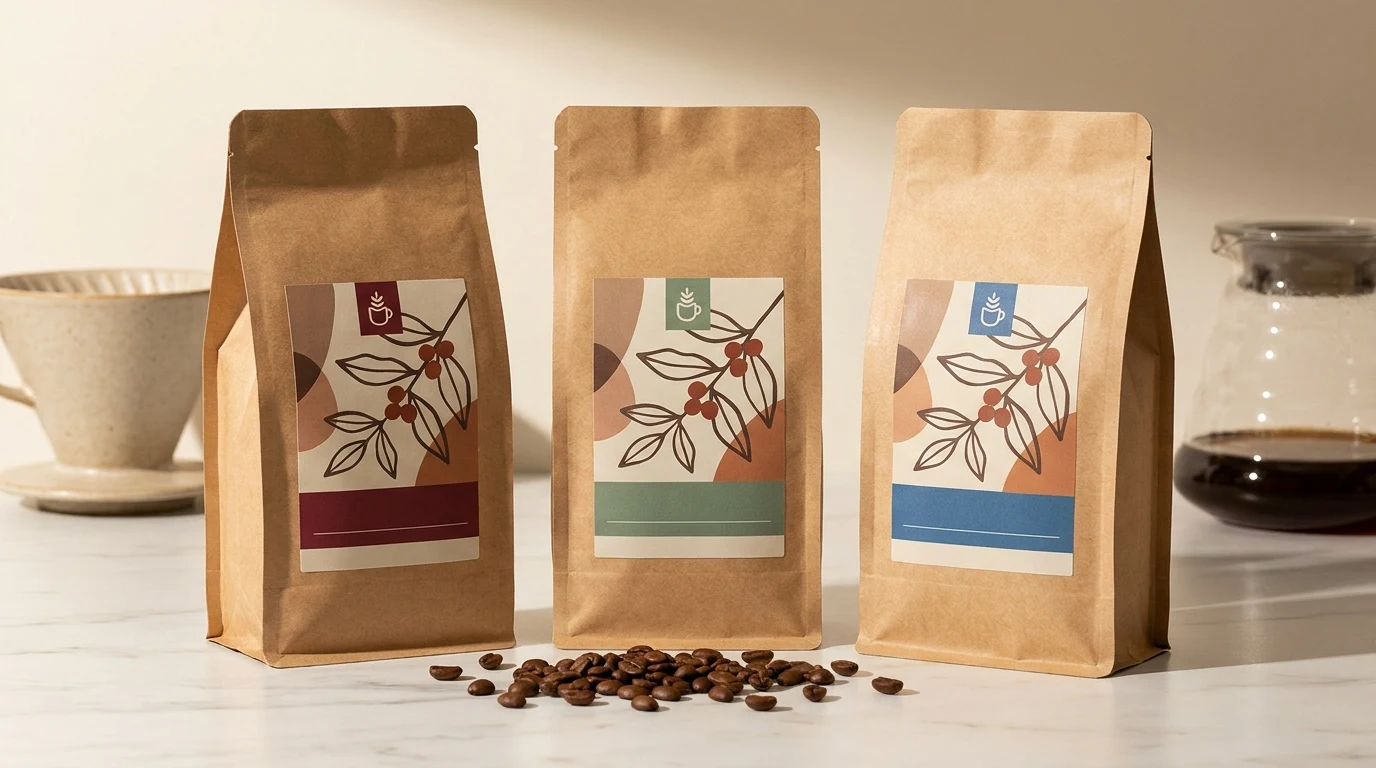
If your Colombia label looks meaningfully different from your Ethiopia — different typography treatment, different hierarchy, different color weight — you're training customers to evaluate each product individually rather than trust the brand.
The most valuable packaging asset you can own is pattern recognition. When someone spots your bag from across a café counter or at a farmers market, without reading the label, because the visual language is unmistakable — that's equity stored in a shape and a color and a type treatment.
Inconsistency across SKUs resets that recognition on every new product launch. It forces customers to re-evaluate rather than extend trust. If you haven't locked in a visual system across your line yet, the four elements of a brand-strong coffee label cover exactly what to standardize first.
Discounting as a first response
This is covered above, but worth naming separately because it's so common. When a roaster's first response to slow sales is a promo code, they're solving a revenue problem by creating an equity problem. The discount works short-term. The positioning damage accumulates — it's one of the clearest patterns in why coffee brands plateau, and one of the hardest habits to reverse once it's set in.
Strong equity brands discount as an exception, not a reflex.
How to Start Building Brand Equity Deliberately
Equity is not built in a campaign. It's built through consistency over time. But there are deliberate decisions that accelerate it.
Lock in your non-negotiables before you need them
The brands that last longest have a small set of things they won't change — a quality standard, a visual anchor, a voice, a relationship with their sourcing partners. These non-negotiables were usually decided early, often intuitively, and have been defended through every external pressure since.
The roaster who refuses to drop to commodity beans even when the margin would be easier. The brand that won't change its label typography even when a trend points elsewhere. The founder who keeps the same tone in every customer email even when the team grows.
These decisions feel small in isolation. Compounded over years, they become the reason the brand is still recognizable at year seven while competitors have been rebranded twice.
Define your non-negotiables in writing before you're under pressure to compromise them. The clarity you have now is worth more than the flexibility you think you need later. Brand voice is one of the first worth locking in — if you haven't documented yours yet, how to build a brand voice that actually sells coffee is where to start.
Packaging as a compounding equity asset
Every bag that leaves your roastery is either building or eroding equity. The unboxing experience, the label hierarchy, the inside-bag copy, the degassing valve placement — none of these are decorative choices. They're equity decisions.
A customer who gets a well-considered bag develops a relationship with the physical object. That relationship influences the repurchase decision more than any email you'll ever send. It's why strong brands don't treat packaging as a cost to minimize. They treat it as infrastructure.
If your current packaging isn't building equity — if it isn't creating the kind of experience customers want to describe, share, or return to — that's the most direct place to start.
Frequently Asked Questions
What is brand equity for a small coffee business?
Brand equity for a small coffee business is the value your brand has beyond the coffee itself — the reason customers choose you at full price, recommend you without being asked, and return without a discount. It's built through consistent quality, recognizable packaging, and experiences that reliably exceed what customers expect. Unlike revenue, equity is a leading indicator: it predicts future performance rather than describing past performance.
How do you measure brand equity for an indie coffee brand?
Measure brand equity through three observable signals: the consistency and accuracy of how customers describe your brand without prompting, whether your full-price conversion rate holds without habitual discounting, and the volume of unprompted organic recommendations (tagged mentions, reviews, forum posts, word-of-mouth referrals). None of these appear in Shopify Analytics. They require actively listening to what customers say about you when you're not in the room.
Why do some coffee brands last and others don't?
The coffee brands that last past year five consistently have three things in common: a small set of non-negotiables they've defended through every market pressure, packaging and product quality that creates genuine word-of-mouth, and a repeat customer rate that doesn't depend on discounts. The brands that don't last typically treat brand-building as a marketing function rather than an operational one — and optimize for acquisition over retention.
What's the difference between brand equity and brand awareness?
Brand awareness measures whether people know your brand exists. Brand equity measures whether knowing your brand creates preference and loyalty. A brand can have high awareness and zero equity — people recognize the name but feel nothing about it and switch easily. Equity is what makes switching feel like a loss. For indie coffee brands, awareness is relatively easy to generate through social media. Equity requires consistency, time, and a product experience that earns it.
Conclusion
Brand equity is not a marketing initiative you run. It's the outcome of a thousand small decisions made in the same direction over long enough that the direction becomes unmistakable.
Revenue tells you last month. Equity tells you year five. The brands that are still here at year five started making equity decisions at year one — often without calling it that. It's the same reason winning coffee brands run one integrated system, not two separate strategies — equity and revenue infrastructure built together, not retrofitted.
The good news is that equity compounds. Every consistent decision you make today is worth more in year three than it is today. Follow us for more on building a coffee brand that lasts.