Your coffee is good. Your store looks presentable. But the sales are not matching the effort — and you're not sure why.
This is the most common problem Inkroast walks into. We've audited and rebuilt Shopify stores for coffee roasters across three continents, and the culprit is almost never the coffee itself. It's the store. Specifically, it's the same five things — in the same places — every single time.
The average Shopify conversion rate across all industries sits around 1.5–3%. For specialty coffee brands selling
direct-to-consumer, you should be targeting the higher end of that range. If you're below 1%, something structural is broken. Here's how to find it and fix it.
The Coffee E-commerce Conversion Problem Nobody Talks About
Most Shopify advice is written for generalist e-commerce stores — fashion, gadgets, supplements. Coffee is different.
Coffee buyers are buying a sensory experience they can't test through a screen. They're also buying into a story — a farm, a roast profile, a ritual.
That changes everything about how your store needs to be built.
What "good" conversion looks like for coffee brands
A well-optimized coffee Shopify store converting at 2.5–3.5% is achievable. The stores Inkroast builds and rebuilds consistently hit this range within 60–90 days of going live.
Below 1% almost always means one of the five problems below is active. Often more than one.
Why generalist Shopify advice fails coffee roasters
A tip like "use high-quality images" means something completely different for a coffee brand than it does for a clothing store. Coffee buyers need to see the bean, the bag, the roast date, and ideally the hands that made it. Generic product photography advice misses all of that. The fixes below are specific to coffee — because that's where the difference is made.
Fix 1 — Your Product Photography Is Killing the Sale
This is the most common and most fixable problem. Most coffee brand Shopify stores have one of two photography problems: lifestyle images that don't show the product clearly, or plain white-background shots that feel clinical and cold.
Neither converts.
What coffee buyers need to see before they trust you
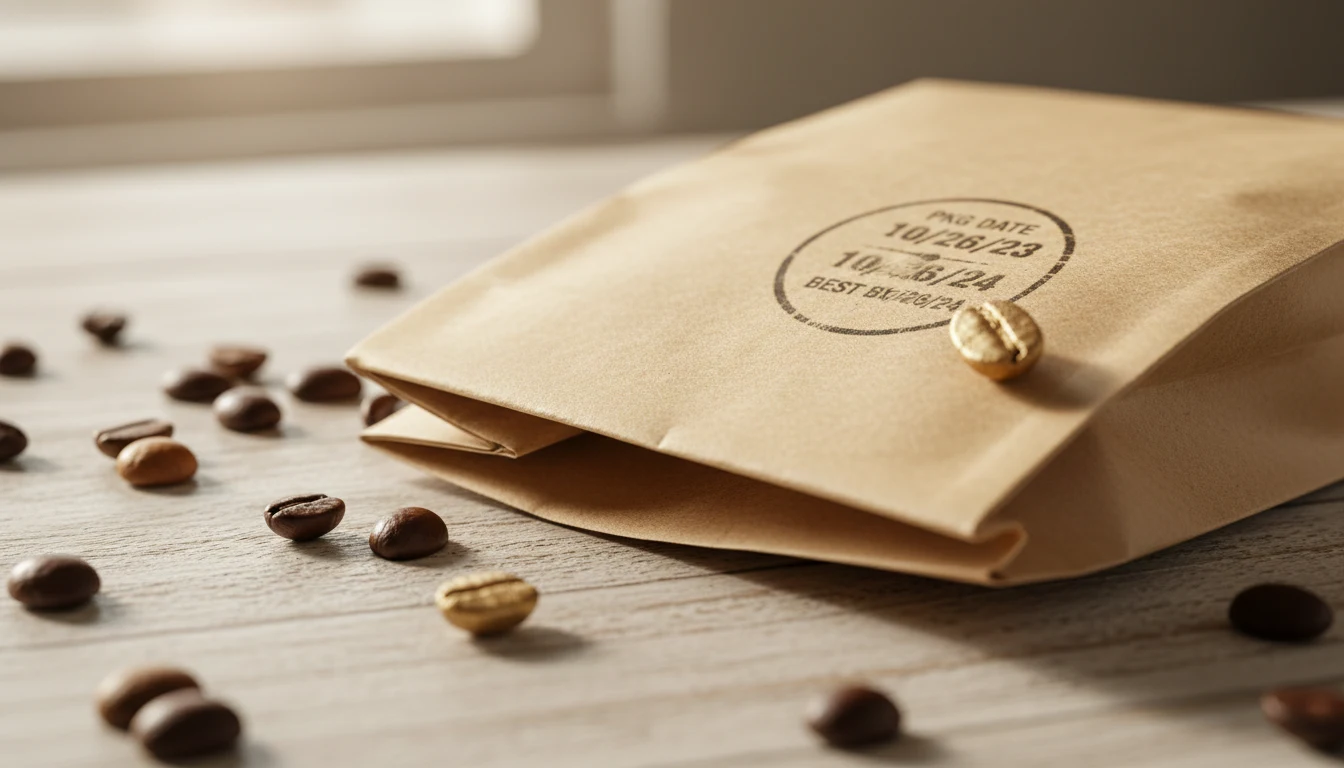
Coffee buyers make purchase decisions based on four visual signals: the bag design (does this brand look credible?), the product itself (can I see the beans, the roast level, the texture?), the context (where does this fit in my life?), and the detail (roast date, origin, processing method — visible, not just in the description).
Your hero image needs to do at least three of these four jobs.
The single image that changes everything
If you're only going to fix one thing today, fix your primary product image. It should show the bag in use — not floating on white. Coffee on a counter, near a grinder, with natural morning light. The bag facing forward, label legible.
Read: How to Brief a Photographer for Your Coffee Brand
Fix 2 — Your Brand Story Is Missing (Or Buried)
Specialty coffee is a trust product. People pay a premium because they believe something — in the farm, the roaster, the process. If your store doesn't communicate that belief clearly and quickly, the price feels unjustified and the visitor leaves.
Where to put it and what it needs to say
Your brand story does not belong only on the About page. It belongs on the homepage, above the fold, in two or three sentences. Not your founding year. Not your mission statement.
The answer to: why does this coffee exist, and why should I care?
One client came to Inkroast with an exceptional single-origin from a family farm in Colombia. It was buried in a generic "premium coffee" tagline. We moved the farm story to the homepage hero. Conversion on that product page increased by 40% in the following month.
Fix 3 — You Have No Social Proof Where It Counts
Reviews exist on most coffee stores. The problem is placement. If your reviews live only at the bottom of the product page —
below the fold, after the description — most visitors never see them.
Reviews, ratings, and trust signals — placement matters
The three places social proof converts: directly below the product title (star rating + review count), in a scrolling testimonial strip on the homepage, and in a "what our customers are brewing" section with real photos. If your reviews are only in one place, you're leaving trust — and revenue — on the table.
The goal is for a first-time visitor to encounter social proof before they have a chance to doubt you.
Fix 4 — Your Navigation Is Making People Work Too Hard
Coffee stores often grow organically — a new origin here, a new blend there, a merch section, a subscription tab. The navigation becomes a list of internal categories that makes sense to you and no one else.
The 3-click rule for coffee stores
A visitor should be able to find, evaluate, and add to cart any product in three clicks or fewer. If your navigation requires a visitor to understand the difference between your "Origins" tab and your "Single Estate" tab before they can find what they want — you've already lost them.
How to structure collections for browsers vs. buyers
Build two navigation paths simultaneously: one for the browser (Story → Blends → Origins → Subscriptions) and one for the buyer (Shop All → Filter by roast/origin → Add to cart). The best coffee Shopify stores do both — usually with a clean top nav for browsers and a persistent "Shop" CTA for buyers.
The Inkroast Shopify Navigation Framework for Coffee Brands
Fix 5 — You're Missing the Subscription or Bundle Offer
A one-time coffee buyer is expensive to acquire and unlikely to return without a reason. A subscriber is your business model. If your Shopify store doesn't have a clear subscription offer — or if it's buried in a separate tab — you're building on sand.
Why one-time buyers don't build a coffee business
The economics are simple: a customer who buys once has an average order value. A subscriber has a lifetime value. For specialty coffee, the average subscriber stays 8–14 months if the product is good and the experience is frictionless.
That changes your entire unit economics.
How to frame subscriptions without feeling pushy
The mistake most coffee stores make is framing subscriptions as a commitment. "Subscribe & Save 10%" is weaker than "Never run out — skip or cancel anytime." The first sounds like a contract. The second sounds like a service. Small copy change, meaningful conversion difference. Inkroast tests both variants on every store we build — the frictionless framing wins every time.
Frequently Asked Questions
What is a good conversion rate for a coffee Shopify store?
A healthy conversion rate for a specialty coffee Shopify store is between 2% and 3.5%. Stores below 1% almost always have structural issues with photography, navigation, or trust signals. Stores above 3.5% typically combine strong brand storytelling, subscription offers, and well-placed social proof throughout the purchase journey.
Do I need a custom Shopify theme for my coffee brand?
Not necessarily. Several premium Shopify themes — including Prestige, Impulse, and Broadcast — work well for coffee brands without customisation. The bigger impact comes from how the theme is configured: photography, copywriting, product structure, and trust signal placement matter more than the theme itself. A custom build makes sense once you're generating consistent revenue and need specific functionality.
How long does it take to see results after fixing a Shopify store?
Most stores see measurable improvement within 30–60 days of implementing structural fixes — particularly to photography, navigation, and social proof placement. Subscription conversion improvements tend to show within the first two weeks. Full results, including SEO impact from content improvements, typically take 60–90 days to reflect in analytics.
Should coffee brands sell on Shopify or Amazon?
Both serve different purposes. Amazon captures high-intent buyers who already know what they want. Shopify builds your brand, owns your customer relationship, and enables subscriptions and storytelling that Amazon can't. For specialty coffee brands, Shopify should be the primary DTC channel — Amazon can be a secondary discovery tool, but it should never replace your own store.
What Shopify apps do coffee roasters actually need?
The core stack for most coffee Shopify stores: a subscription app (Recharge or Skio), a reviews app (Judge.me or Okendo), an email and SMS platform (Klaviyo), and a bundle builder if you sell gift sets or sampler packs. Beyond those four, most additional apps add complexity without proportional conversion value.
The Store That Sells Is the Store That Trusts
The five fixes above are not design opinions. They're the patterns Inkroast has seen across every coffee brand Shopify store we've built or audited. Photography, story, proof, navigation, subscriptions — in that order, because that's the order your visitor encounters them.
You don't need a full rebuild to start. Pick the fix that matches your biggest drop-off point and start there. If you're not sure where visitors are leaving, your analytics will tell you — and if you want a second set of eyes, Inkroast offers store audits for coffee brands at every stage.
Fix one thing this week. Measure it. Then fix the next.
Read: The Inkroast Shopify Navigation System