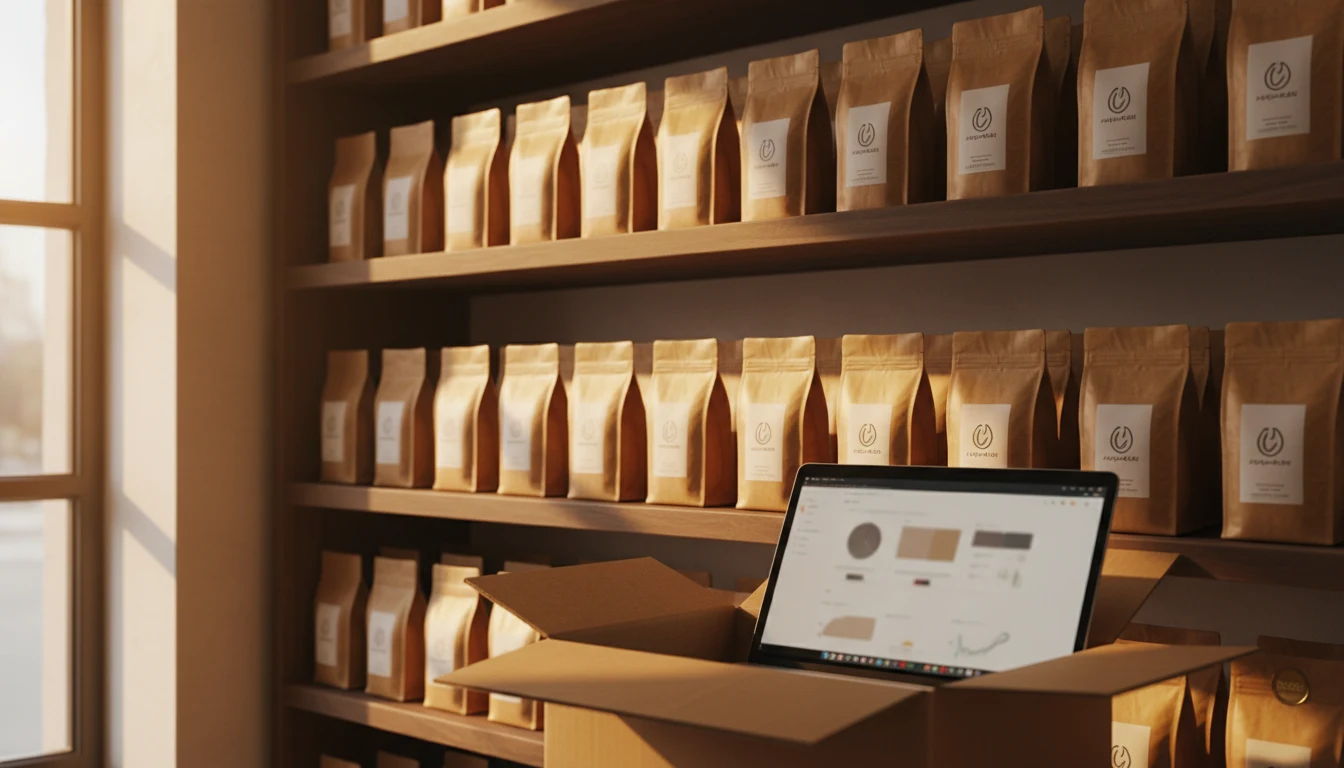
A Shopify store can sell more of a coffee SKU than the packaging line has actually finished producing — and the store owner usually finds out the moment an order comes in that the printed bags, the labels, or the inventory count can't back up.
This gap sits between two teams that rarely compare notes: whoever manages the Shopify listings and whoever manages the packaging reorder calendar. Across the stores we've audited heading into a Q4 season, that gap is close to universal, and it's invisible right up until the first holiday order lands on a SKU that isn't actually ready. This check sits on top of getting the four elements of a brand-strong label right in the first place — a label that looks right but isn't backed by real inventory still ends in the same canceled order.
The Gap Between "Sellable" and "Shelf-Ready"
A SKU is sellable the moment it's live on the Shopify store with a price, a photo, and inventory showing in stock. A SKU is shelf-ready only once it's packaged, labeled, barcoded, and physically sitting in inventory, ready to pick and ship today. Those two states get treated as the same thing almost everywhere — until Q4 volume finds the difference. The same logic applies to briefing a photographer for your coffee brand — product photography is another asset that has to exist before a SKU goes live, not scrambled together after it's already sellable.
Why This Gap Is Invisible Until Q4
At normal volume, a small buffer between sellable and shelf-ready barely matters — a slow trickle of orders gives the packaging line time to keep pace quietly in the background. Q4 removes that buffer. A spike in orders on a single SKU can outrun what's physically packaged within days, and by the time anyone notices, it's a fulfillment delay or a canceled order, not a calm fix.
The One-Hour SKU Cross-Check
The fix doesn't require new software or a new process — it requires one list, compared against another, once, before Q4 traffic arrives.
What Counts as Shelf-Ready
Packaged, labeled, barcoded, and physically counted in inventory today. Not "the print run ships Friday." Not "we have the bags, just need to label them." If it can't be picked and shipped in the next hour, it isn't shelf-ready yet — it's still in production.
What Doesn't Count (Even If It Feels Close)
A finished print run still in transit from the printer. Labels in hand but not yet applied. A SKU that's "basically done" pending one more quality check. Each of these feels close enough to round up to shelf-ready — and each one is exactly where the gap hides, because rounding up is what makes a real number feel confirmed when it isn't yet.
Why Packaging Lead Time Is the Real Constraint
The Shopify side of a store can change in minutes — a SKU goes live, a quantity updates, a new variant gets added. The packaging side can't. A print run typically takes four to six weeks from order to delivery, and that timeline doesn't compress just because Q4 traffic is about to spike. Any SKU count decision made without checking that lead time is a decision made against a constraint nobody consulted. It's the same discipline behind syncing inventory across every sales channel — a shelf-ready count that's accurate on Shopify but wrong on a wholesale spreadsheet is the same gap wearing a different name.
A Real Example From Our Audits
Across the coffee brands we've worked with (see our project case studies at inkroast.com/projects), the pattern that shows up most often isn't a brand overselling on purpose — it's a brand whose Shopify listing was updated the day a new blend was finalized, while the actual packaging order for that blend was still four weeks from arriving. Nobody was wrong. Nobody checked the other side of the gap. The same applies to a brand voice that actually sells coffee — new-SKU copy needs to be ready at the same time the packaging is, not written after the gap is already found.
Frequently Asked Questions
What's the difference between a sellable SKU and a shelf-ready one?
A sellable SKU is live on the Shopify store with a price and photo, showing available inventory. A shelf-ready SKU is physically packaged, labeled, barcoded, and sitting in stock right now, ready to pick and ship without waiting on a print run or a labeling pass.
What if I find a gap this close to Q4?
Pause the Shopify listing or reduce its visible inventory count to match what's genuinely shelf-ready today, then place the packaging reorder immediately, sized to Q4 sell-through expectations rather than the calmer volume the last order was based on.
Should I just unlist SKUs that aren't shelf-ready yet?
Not necessarily — reducing the visible quantity to match real stock is usually enough, since it keeps the SKU discoverable while preventing an oversell. Full unlisting only makes sense if the packaging timeline won't close before the SKU would realistically sell out.
How often should this cross-check run?
Monthly is enough during normal volume. Heading into Q4, run it once in August or early September while there's still enough runway to place a packaging reorder, and once more in late October as a final confirmation before peak traffic arrives.
Does this apply to made-to-order or small-batch SKUs too?
Yes, though the shelf-ready bar shifts slightly — for made-to-order, "shelf-ready" means the packaging materials and roast capacity to fulfill the promised turnaround are confirmed, not that finished units are sitting in a warehouse.
Conclusion
The gap between what a Shopify store can sell and what a packaging line has actually finished producing costs nothing to check and a real order to ignore. One list of sellable SKUs, one list of shelf-ready SKUs, one hour comparing them — run now, while there's still enough lead time left to close whatever gap turns up. It's one system, not two disconnected strategies — packaging and Shopify only work when someone checks both sides.
Follow us for more.